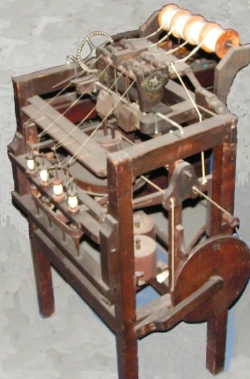
ONE of the great, unanswered questions of modern history is whether the credit for kick-starting the Industrial Revolution was given to the wrong men.
The text books tell us that James Hargreaves invented the Spinning Jenny, Richard Arkwright the Water Frame and Samuel Crompton the Mule.
But there is a disturbing possibility that another man, now virtually unknown, was robbed of the title to two, if not all three, of the machines that helped to change the world.
It's a story of intrigue, collusion and outright skullduggery, a nasty game played for the highest stakes with one man - almost certainly the wrong man - coming out on top.
Thomas Highs - the name was probably Heyes, misspelled by the registrar - was born in Leigh, Lancashire, in 1718. Sources agree he was a talented reedmaker - a reed was a comb-like strip attached to the batten of a loom, which kept the warp threads apart and helped the weaver to pack the weft threads tight on the newly-woven cloth.
In 1752, five years after his marriage to local girl Sarah Moss, he began experimenting with the drafting rollers that were later to change the face of the industry. He did not invent roller-drafting - credit for that goes to Lewis Paul and John Wyatt, who patented the idea in 1738. But he probably succeeded where they failed, and turned rollers into a practical proposition.
The flying shuttle had been invented by John Kay 20 years earlier was taking over on Lancashire cotton handlooms, and the race was on to find a machine that would meet the spiralling demand for cotton thread.
Highs probably realised that the intricate mechanics required to make drafting rollers perform were beyond his abilities; he teamed up with a clockmaker, John Kay.Note: This was not the same John Kay who had invented the Flying Shuttle.
Behind locked doors, Highs and Kay laboured for months, ignoring the taunts of their neighbours, but eventually became so frustrated that one Sunday evening, they opened the garret window of Highs's house and tossed the machinery out into the back yard. Kay went home dejected. Next morning Highs had second thoughts, gathered up the bits and reassembled them. Eventually, in 1764, he produced a machine which did not involve rollers. This he christened the Spinning Jenny.
We know the date from a man named Thomas Leather, whose father Richard had taken a public house, called the Seven Stars, in The Walk in Leigh in May, 1763. The Leathers stayed there until May, 1766, during which time Highs and Kay were his neighbours. In the first or second of those years - ie 1763 or 1764 - Leather attested, Highs built his first Jenny.
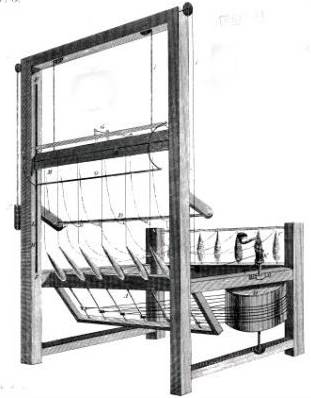
THOMAS HIGHS'S Spinning Jenny, an illustration from Edward Baines's History of the Cotton Manufacture in Great Britain.
Why 'Jenny'? There are three possibilities. The first is that Highs named it after his daughter, Jane - there is a sworn statement from Leather that this was the case. The second is that the word is a corruption of 'engine', as in Whitney's cotton gin. The third is that the word is an allusion to the name for a female ass, a beast of burden that would take a load of work off the shoulders of man. It may have been more than coincidence that Crompton's later development was called a mule.
In its original form, the Spinning Jenny was about a metre square and produced six threads of cotton as fast as a hand-spinner could make just one. It was also capable of development but Highs, without the money to patent his idea, cashed in instead by building machines for hire.
However, Highs knew the Jenny's limitations. It could produce only thread that was suitable for weft. Its output was too soft to be used for warp, which still had to be manufactured from linen.
What happened next is unclear. There is a suggestion, but no evidence, that Highs handed the Jenny over to James Hargreaves and returned to tackle the more complicated problem of spinnuing using drafting rollers.
Note: Those who attribute the invention of the Spinning Jenny to Hargraves claim that he, Hargraves, named the machine after one of his own children, He would have had thirteen options: the Spinning Susan, Ellen, Henry, Christopher, John, Mary, Betty, Jonathan, Harry, Ann, Alice or George. Perhaps after his wife, the Spinning Elizabeth. There was no Jenny Hargreaves. By the time Hargreaves began working on the Spinning Jenny it already had a name. It had been named by Thomas Heyes after his daughter Jenny.
So in 1767, Highs was putting the finishing touches to what would become known as the Water Frame.
.The name Water Frame stms from the fact that the machine required too much power to be hand cracked and needed to be driven by a Water Wheel - later by a steam engine. The Water Frame was also know as the Throstle since when working it sang like a bird.Whereas the Jenny had stretched the thread by trapping it in a sort of wooden vice and pulling it out, the Water Frame achieved better results by passing the roving through two sets of gripping rollers.